periodontal and dental implants logo 01
Medically Reviewed By Periodontal & Implant Surgeons of Houston
5 May 2026
Home » All-on-4 treatment » Choosing All-on-Four Dental Implants for Full Arch Tooth Loss

Losing most or all of your teeth rarely happens overnight. Understanding why it happened is the step most patients skip before exploring what comes next.

For the majority of people who lose most or all of their teeth, it often involves an underlying health condition, a medication, or a systemic process that’s accelerating tooth loss. And that story matters, because it affects exactly how a  treatment should be planned, and what needs to be evaluated before a patient is ready for surgery.

Why Teeth Loss Matters Before All-on-Four dental Implants

Why Your Teeth Were Lost Matters as Much as the Fact That They Were

There’s a common assumption that once the teeth are gone, the underlying cause stops being relevant. In implant dentistry, that’s not how it works. The same conditions that cause tooth loss often affect the jawbone and gum tissue that implants rely on and walking into a consultation without this context can mean getting into a treatment plan that isn’t for you. 

Here are the most common medical contributors to full arch tooth loss, and why each one has bearing on treatment planning.

Gum disease is the leading cause of tooth loss in adults over 35, and it’s far more than a dental hygiene issue. Gum disease, in its advanced form, is a chronic inflammatory condition that destroys the bone holding your teeth in place. It tends to progress slowly and quietly and most people don’t realize how much bone they’ve lost until they’re looking at X-rays. The complication for implant planning is that the bone destruction doesn’t stop when the teeth come out. The tissue and bone that remain are what implants will be anchored into, and their condition shapes what the surgical plan needs to account for.

Diabetes has a well-documented relationship with aggressive gum disease and tooth loss. High glucose levels reduce the body’s ability to fight infection and slow down healing and both these factors are critical to maintaining teeth and to recovering from implant surgery. For patients with a diabetic history, the quality of their bone and their capacity to heal after surgery are critical considerations. 

Osteoporosis reduces bone density throughout the body, and the jaw is no exception. Patients who take bisphosphonate medications for osteoporosis require careful evaluation before implant placement, because these medications affect the way bone heals and responds to surgical procedures.

Dry mouth from medication  surprises a lot of patients, but it’s one of the most common hidden contributors to widespread tooth loss, particularly in people over 50. More than 500 frequently prescribed medications reduce saliva production as a side effect. Saliva actively protects teeth by washing away bacteria, neutralizing acids, and helping to repair minor damage to enamel. Without enough of it, decay can spread rapidly across multiple teeth at once. Many patients who come in with full arch decay concentrated over just a few years have a medication list that explains the pattern entirely.

Radiation treatment to the head or neck can permanently damage the salivary glands and, in some cases, reduce blood flow to the jawbone itself. This can make the jaw more vulnerable, slower to heal, and in certain cases less predictable as a foundation for implants. Patients with this history need a specialist who understands what that means for surgical planning.

Chronic acid reflux (GERD) reaches the mouth and erodes tooth enamel over time, particularly on the upper front teeth and the chewing surfaces of the back teeth. For patients with years of untreated or undertreated reflux, the erosion can compromise multiple teeth to the point where they’re no longer salvageable.

What Happens to the Jaw When Teeth Are Missing

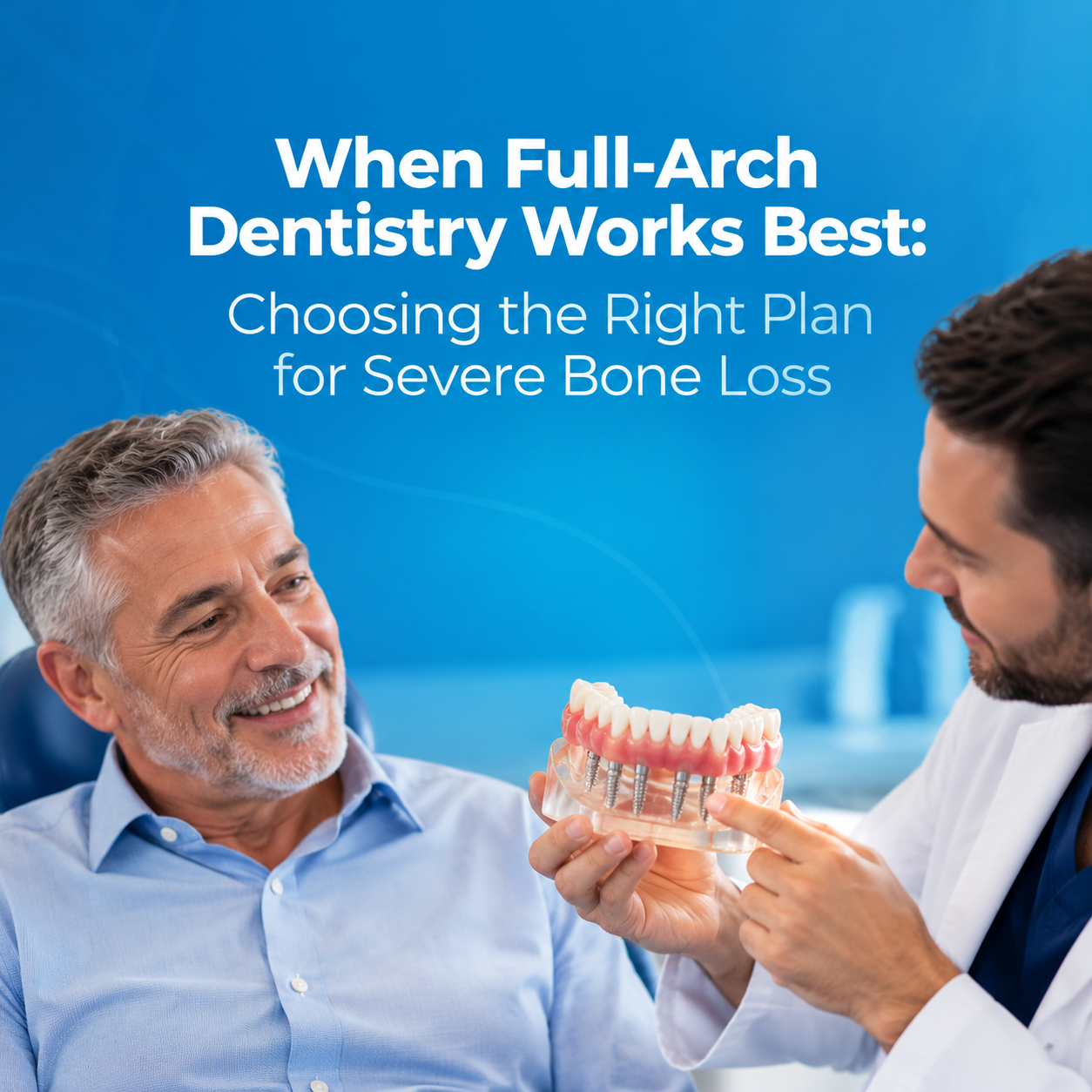
The roots of your teeth put pressure into the jawbone every time you bite or chew, and that pressure is what signals the bone to maintain itself. When a tooth is extracted and that signal disappears, the body treats the bone in that area as no longer necessary and gradually breaks it down in a process called bone resorption.

It happens on a fairly predictable schedule. In the first six months after a tooth is lost, the jaw can lose up to 25 percent of its width at that site. Over the following months, losses continue. By the time a year has passed, the jaw may have lost 40 to 60 percent of its original width in the areas of missing teeth. In the back of the upper jaw, there’s an additional complication: the sinus cavity, which sits just above those tooth roots, tends to expand into the space that bone used to occupy.

For All-on-Four dental implants, this matters because the procedure depends on having enough bone in specific areas to anchor the implants securely. The technique is designed to work with less bone than traditional implant approaches require, but it still requires a certain threshold. When patients delay treatment, the bone that would have supported a relatively straightforward procedure may have resorbed to a point where additional surgery is needed first, such as a bone graft or a procedure to create space below the sinus floor. That adds time and cost to the overall treatment.

Dr. Arun Vashisht, a board-certified prosthodontist of Periodontal and Implant Surgeons of Houston, has seen this pattern consistently across nearly two decades of full arch cases:

One of my most consistent findings in full arch cases is that patients who waited a significant time arrive with significantly less bone to work with than they would have had twelve or eighteen months earlier. Bone resorption after extraction is not a complication. It is a biological certainty. When patients delay, the complexity of the procedure always increases. A case that would have been straightforward at nine months post-extraction may require sinus augmentation or ridge grafting at twenty-four months. The implants placed are just as capable of lasting decades either way but the path to getting there is longer and more involved the later the evaluation begins.

Why a 3D Scan Is the Starting Point for Any Honest Treatment Plan

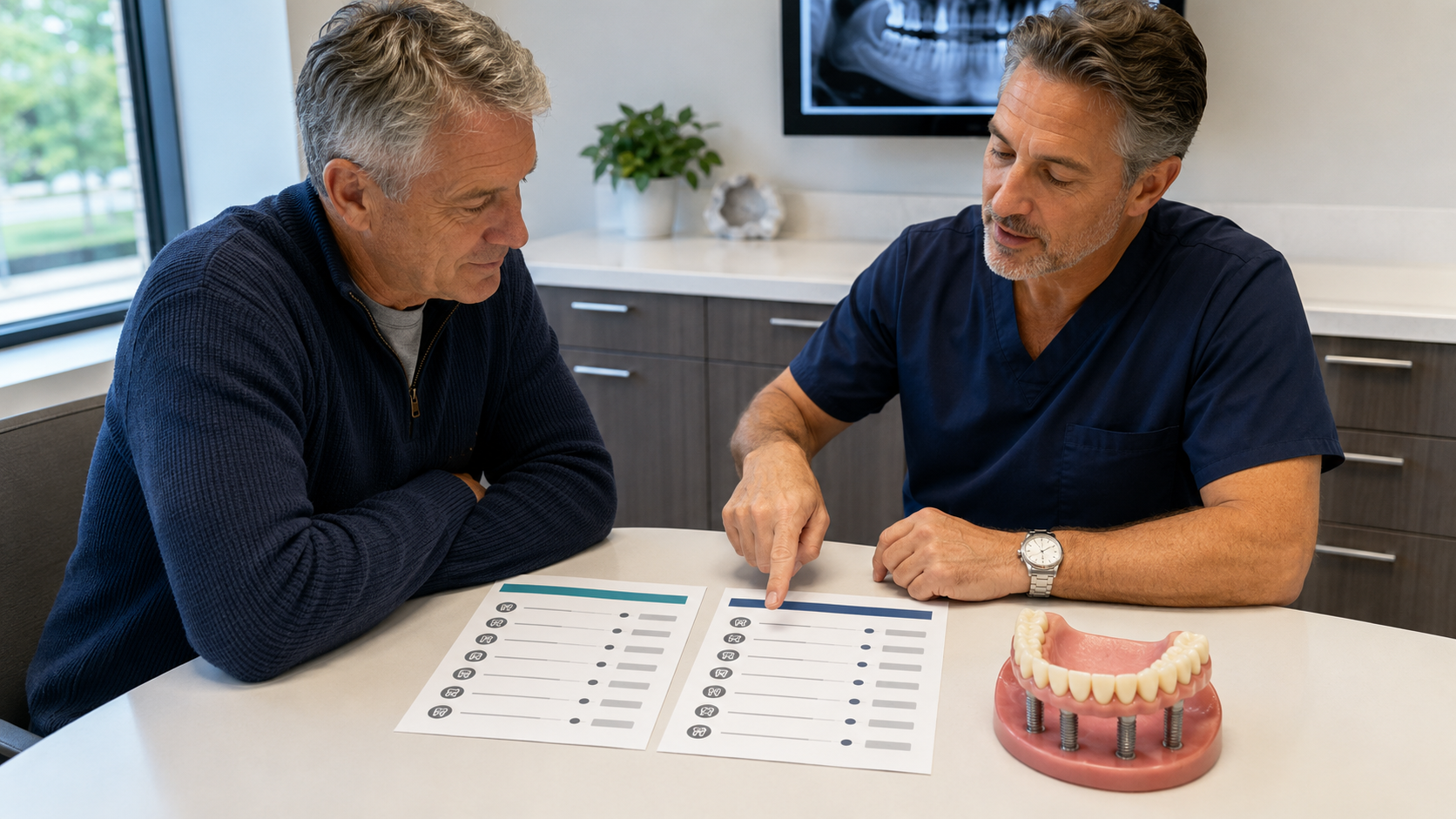
A regular dental X-ray shows a flat picture of what’s there. It doesn’t show how much bone exists in three dimensions, where the sinus floor sits, or where the nerve that runs through the lower jaw is located. For All-on-Four dental implants planning, the level of detail is what separates a treatment plan built on information from one built on estimates.

A cone beam CT scan provides a 3D scan of the jaw, which gives the surgical team an accurate map of bone volume and anatomy before any decisions are made. It tells them whether the bone is deep enough and wide enough where implants need to go, whether extra procedures will be needed first, and exactly how to position each implant for the best long-term result.

It also connects back to one’s medical history. A patient whose tooth loss was driven by gum disease will often show diffuse bone loss across the arch. A patient whose loss came from medication-related decay may have much better bone preserved underneath. The scan shows what’s there now; the history explains why.

The cost of full mouth dental implants in Houston, including All-on-Four dental implants, depends significantly on what the scan and clinical evaluation reveal. Whether bone grafting is needed, how many arches are being treated, and what type of prosthesis is selected all affect the final number. Any practice quoting All-on-Four dental implants pricing without imaging is working from incomplete information.


A Note on Where to Start

For patients in Houston who have lost most or all of their teeth, are currently in a removable denture, or have been told elsewhere that they aren’t implant candidates because of bone loss, the right starting point is a specialist evaluation that includes 3D imaging to understand the full picture before beginning.

Periodontal and Implant Surgeons of Houston sees full arch cases at their practice on S. Gessner Road, with cone beam CT assessment available on-site. Dr. Vashisht leads full-arch prosthetic rehabilitation alongside a team that covers both the surgical and prosthetic sides of treatment.

Schedule a Consultation