periodontal and dental implants logo 01
Medically Reviewed By Periodontal & Implant Surgeons of Houston
22 September 2026
Home » All-on-4 treatment » When Full-Arch Dentistry Works Best: Choosing the Right Plan for Severe Bone Loss

All-on-4 Implants for Severe Bone Loss“All-on-4 implants” have become something of a household term.

And often, it is a great option. All-on-4 implants are dental implants designed specifically for situations where a patient has lost most or all of their teeth in an arch, often along with significant bone loss. The “4” refers to four implants placed at strategic angles to support a full arch of replacement teeth, a design that works well when there isn’t much bone left to work with.


What Full Mouth Rehabilitation Actually Means

Full mouth rehabilitation refers to restoring all (or nearly all) of the teeth in your mouth, whether that’s through implants, dentures, crowns, bridges, or some combination. All-on-4 is one specific approach within that broader category, well-suited to certain situations.

In cases where someone has lost most of their teeth and has significant bone loss (sometimes called an “atrophic jaw,” meaning that the jawbone has shrunk significantly from years without teeth to support), the natural path forward is to consider a full-mouth rehabilitation treatment,

How Severe Bone Loss Changes the Conversation

When someone has been missing most of their teeth for a long time, the jawbone in that area has typically lost significant width and height. This is simply what happens to bone that’s gone unused for years. Such a condition renders the usage of standard implants useless as implants are anchored in the bone below it.

All-on-4 implants were actually designed with this in mind. By angling the back implants rather than placing them straight up and down, the technique can often anchor into bone that’s still present in areas that haven’t dissolved as much, allowing implants to be placed without bone grafting, even in people with significant bone loss.

In cases of truly severe bone loss, even the angled approach may not have enough solid bone to anchor into securely. That’s where the plan needs to adapt.

What CBCT Imaging Tells Us

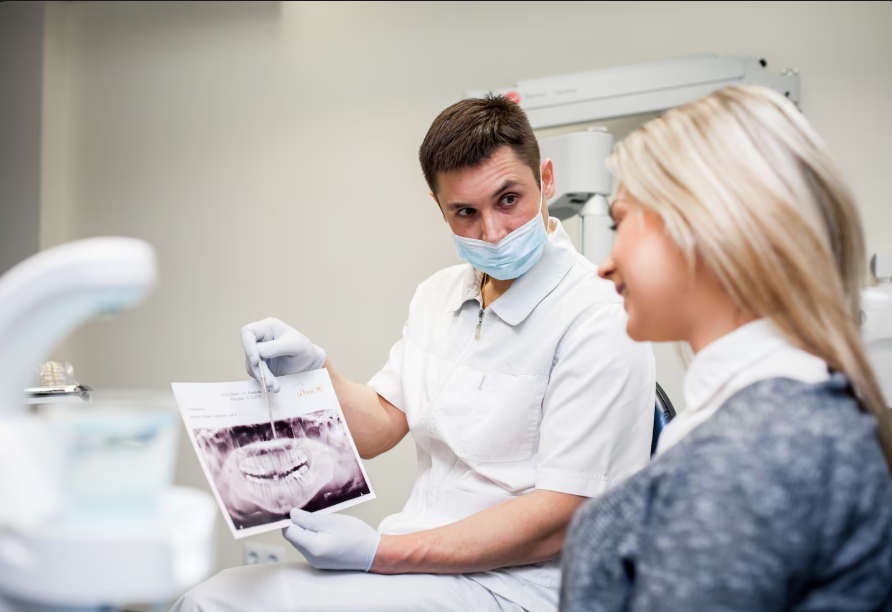
For any array of teeth loss cases, imaging is essential rather than optional. A CBCT scan, which is a 3D X-ray of the jaw, lets us see exactly how much bone is present, its location, and its density in every direction.

From that scan, we can usually determine answers to questions like “Is there enough bone in the right locations for a standard All-on-4 implant placement?”, “Would a modified angle or implant position work better given this specific anatomy?” “Does this case need bone grafting first, with implants placed afterward once the graft has healed? Or is a different full-arch approach the more predictable path?”

None of these answers come from a conversation alone. They come from seeing the actual bone.

A Patient’s Path: From “I Need All-on-4” to the Right Plan

Dr.Arun Vashisht, Prosthodontist and Co-Owner at Periodontal and Implant Surgeons of Houston recalls “A patient came to the clinic having done their research as they’d read about All-on-4 implants, understood the concept, and were confident it was the answer to their missing teeth problem.

The CBCT scan said that the bone loss in certain areas was more advanced than is typical. Rather than force the standard plan onto anatomy that didn’t quite fit it, I discussed a modified implant arrangement that worked with the bone that was actually available.”

This is really the heart of it.  All-on-4 is an excellent technique, and for many patients with bone loss, it’s exactly the right call. But “right call” should come from looking at that person’s jaw and not from the popularity of a treatment’s name.

Questions Worth Asking

If you’re considering full-arch implants and have been told you have significant bone loss, a few questions are worth raising at your consultation: Has a 3D scan (CBCT) been done to actually measure the bone that’s present? Does the recommended plan account for the specific areas where bone loss is greatest? If grafting is recommended, what would the alternative without grafting look like, and why was one chosen over the other?

These aren’t questions meant to create doubt. They’re meant to make sure the plan you move forward with is based on your anatomy specifically, not a one-size-fits-all assumption.

At Periodontal and Implant Surgeons of Houston, every full-arch case begins with detailed imaging that shows us exactly what we’re working with and next steps include laying out realistic options so patients can move forward with a plan built around their case.