periodontal and dental implants logo 01
Medically Reviewed By Periodontal & Implant Surgeons of Houston
5 July 2026
Home » All-on-4 treatment » All-on-4 Dental Implants vs Traditional Implants: Cost, Benefits and Who Is a Candidate?

Patients who lose most or all of their teeth generally have two broad treatment approaches. One involves replacing missing teeth with individual implants where appropriate. The other uses four strategically placed implants to support an entire arch of replacement teeth. 

Understanding the difference between All-on-4 dental implants and traditional implants in Houston, and knowing which one suits a specific clinical situation, is what separates a treatment plan built around a patient’s anatomy from one built around a preset protocol.

All-on-4 Dental Implants vs Traditional Implants

What Traditional Dental Implants Involve

A traditional dental implant replaces a single missing tooth from the root up. A titanium post is placed into the jawbone at the exact site of the missing tooth, integrates with the surrounding bone over several months, and then supports a crown that functions like a natural tooth.

For patients missing one, two, or several non-adjacent teeth with adequate bone at each site, individual implants are typically the most anatomically precise solution. Each implant is independent. Each restoration is specific to that tooth. The result functions and feels closest to what was there before.

The limitation of this approach for patients with full arch tooth loss is straightforward: replacing every tooth with its own implant requires bone volume at every site, enough implants to support the full arch, and a surgical scope that increases with the number of missing teeth. For patients who have experienced significant bone loss across the jaw, this approach often requires extensive bone grafting before placement can proceed.

What All-on-4 Was Designed to Do

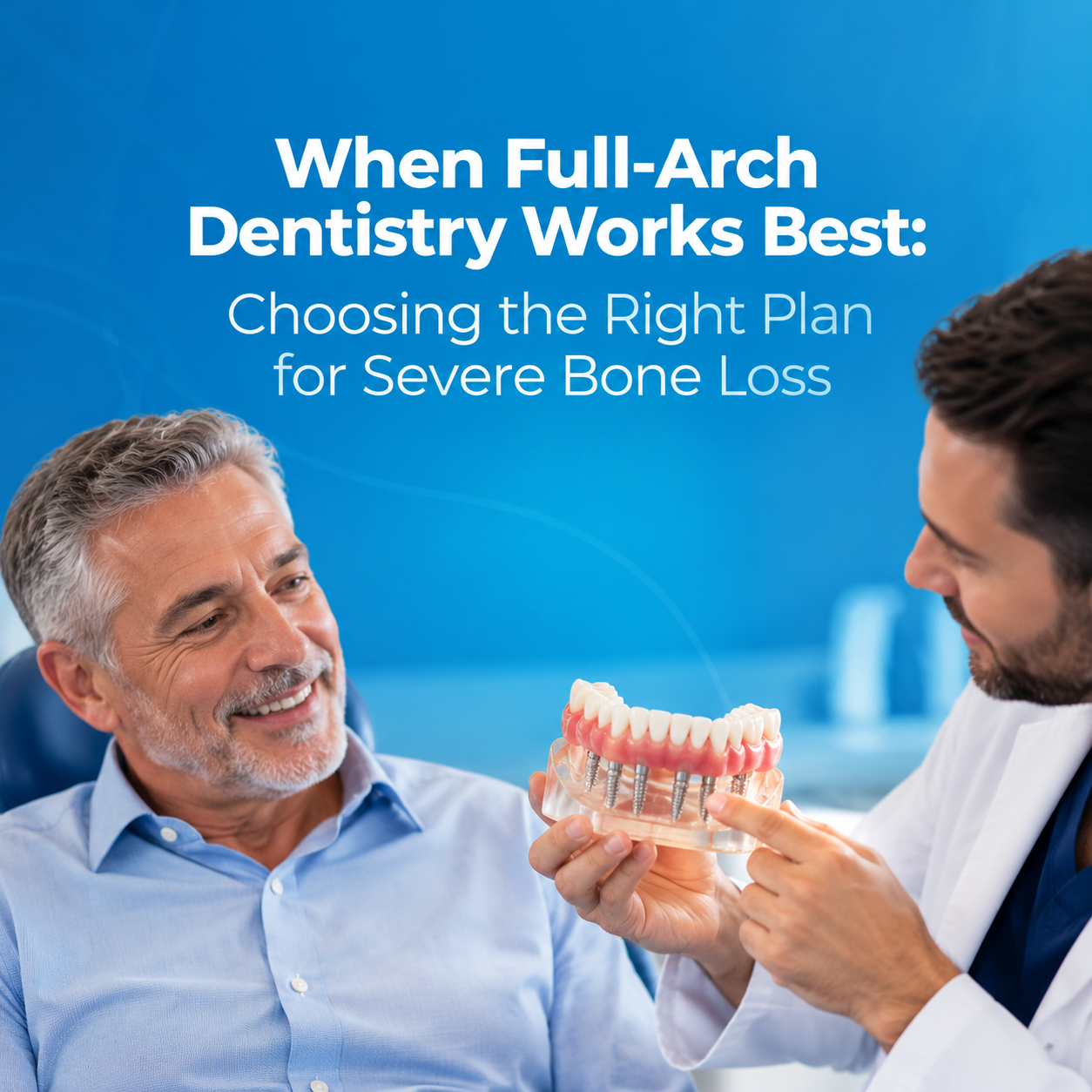
All-on-4 dental implants in Houston address a specific clinical problem, which is to restore a full arch of teeth in a jaw that has experienced bone loss, often reducing or eliminating the need for extensive bone grafting 

The technique places four implants per arch, with the two posterior implants angled at roughly 45 degrees rather than vertically. That angulation allows the surgeon to reach denser, more available bone further back in the jaw, in areas where resorption tends to be less severe. Four well-positioned implants can then support a full arch prosthetic, either an acrylic hybrid or a zirconia restoration, without requiring the bone volume that conventional full arch replacement would demand.

For patients with an atrophic jaw or severe bone loss who would otherwise need significant preparatory surgery before traditional implants, the All-on-4 approach has helped many patients who were previously told they lacked sufficient bone discover that, after comprehensive evaluation, a fixed implant solution may still be possible. 

What Drives the Cost Difference 

All-on-4 dental implants cost in Houston varies based on the materials used for the final prosthetic, whether any preparatory treatment is needed, and the complexity of the case. The full-arch acrylic hybrid restoration that most All-on-4 cases begin with is less expensive than a full-arch zirconia restoration, which is more durable and more aesthetic over the long term.

Traditional implants, priced per tooth, can exceed the cost of All-on-4 significantly when a patient needs a full arch replaced. For patients missing most or all of their teeth, the comparison usually favors All-on-4 both in overall cost and in surgical complexity, since a full-arch prosthesis can often be supported by four strategically placed implants instead of placing an implant for every missing tooth. 

The more important cost comparison, though, is between any implant solution and doing nothing. Bone resorption naturally occurs after tooth loss because the jawbone no longer receives stimulation from the tooth root.  Patients who defer full arch implant treatment for years often find the eventual case more complex and more expensive than it would have been earlier.

Candidacy: What the CBCT Actually Determines

An anonymous patient came through Periodontal and Implant Surgeons of Houston after consultations at two other practices, both of which had indicated that significant grafting would be needed before implants were possible. The patient had multiple missing teeth and had been told their bone loss was too advanced for a straightforward implant plan.

CBCT imaging at PISH told a more specific story. The bone loss was real, but its distribution was uneven. Certain posterior sites had more available density than the panoramic films elsewhere had suggested. A modified full arch dental implants plan, with two implants placed at angles to access that denser bone, was viable without a separate grafting phase.

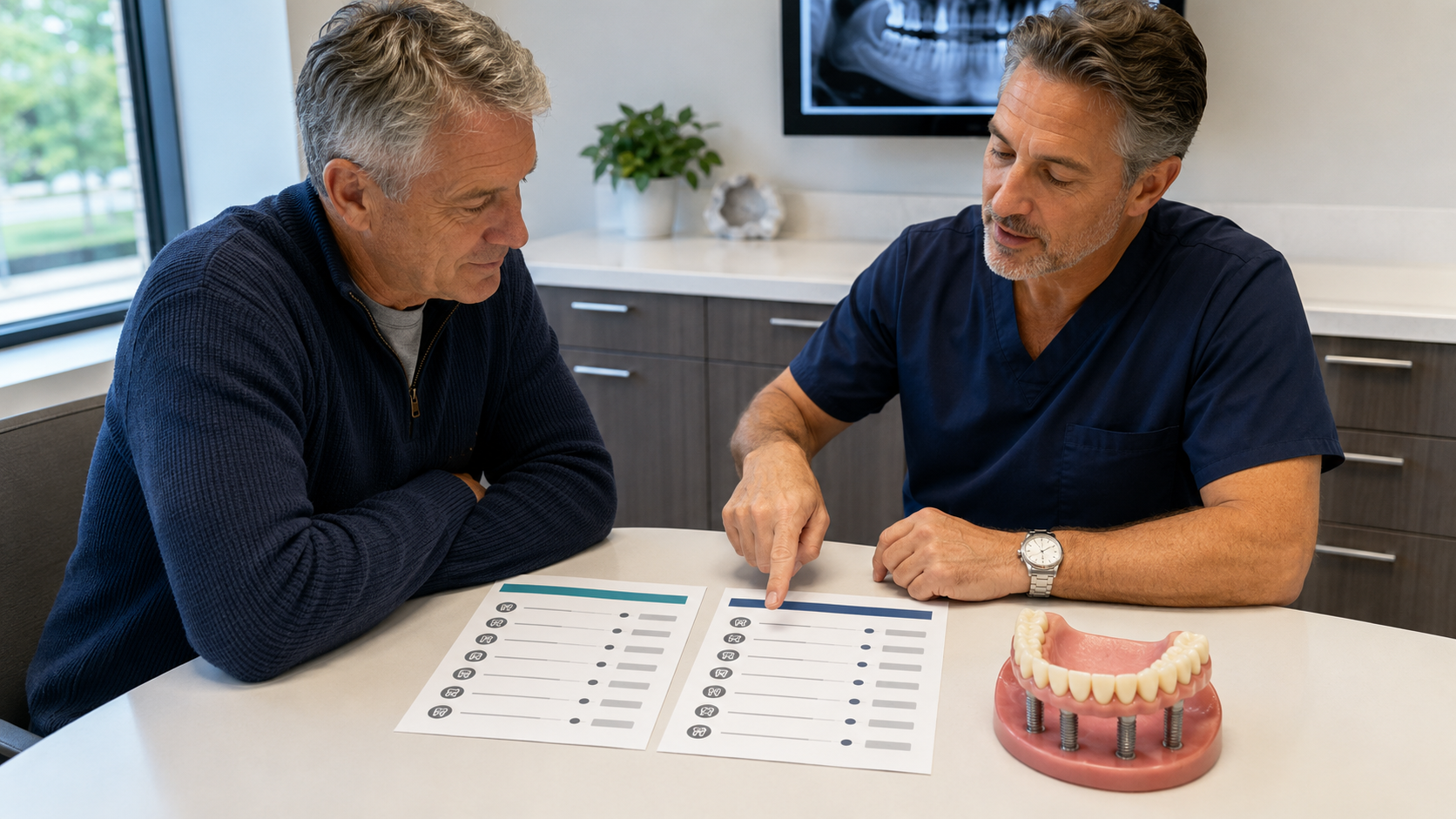
Dr. Arun Vashisht describes what that evaluation process involves: “The CBCT gives us a three-dimensional view of where the bone actually is, not just whether bone is present. Before I recommend All-on-4 dental implants or any full arch restoration in Houston, I want to know the width, the height, and the density at every potential placement site. That’s what tells me whether the standard four-implant configuration works for this patient’s anatomy, whether a modified plan makes more sense, or whether preparation is genuinely necessary first.”

Full Arch Restoration in Houston: Choosing the Right Plan

For patients evaluating implant supported dentures in Houston against fixed implant solutions, the distinction worth understanding is not just aesthetic. Fixed full-arch restorations and implant-supported overdentures each offer advantages. Fixed restorations generally provide greater stability and may help preserve bone more consistently across the arch, while removable implant-supported overdentures can still provide important functional and bone-preserving benefits compared with conventional dentures. 

Full mouth reconstruction in Houston at PISH begins with imaging, not with a preset recommendation. The clinical team reviews bone volume, jaw anatomy, bite forces, and the patient’s restoration goals before a treatment plan is presented. The goal is matching the approach to the case, not the case to the approach.

Periodontal and Implant Surgeons of Houston evaluates all-on-4 dental implants candidates through comprehensive CBCT imaging and clinical examination.

Call (281) 389-2057 or visit dentalimplantsathouston.com to schedule a consultation. A comprehensive clinical examination and CBCT evaluation are essential to determine which treatment approach is most appropriate for your individual anatomy, oral health, and treatment goals.